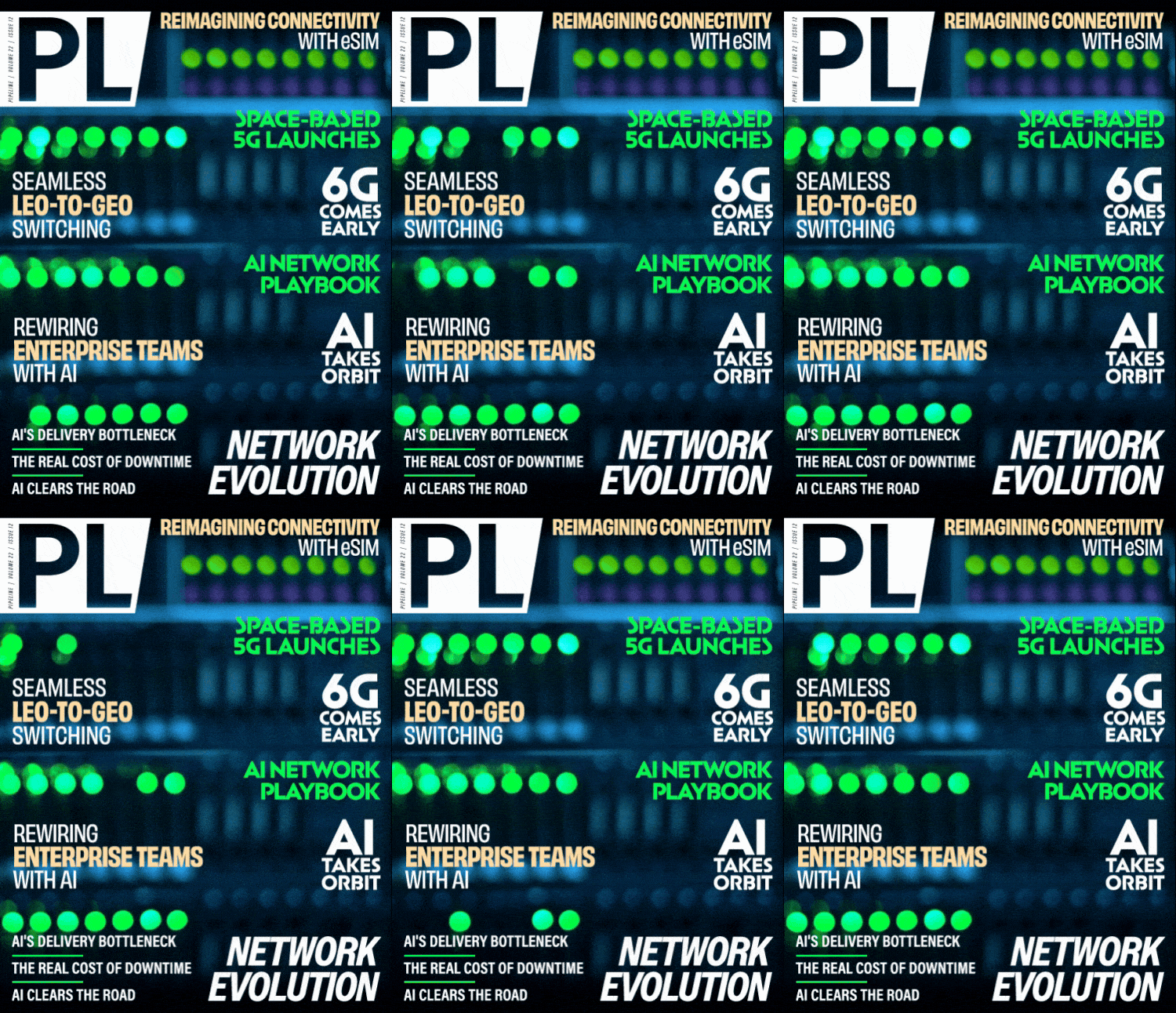
By: Dr. Philipp Schulte
The telecommunications industry has largely moved beyond asking whether eSIM will become mainstream. That question has already been answered. Over the past several years, eSIM has quietly
become foundational to digital connectivity strategies across consumer devices, connected vehicles, industrial IoT, healthcare, utilities, and enterprise mobility. The more important question now
is whether enterprises, mobile operators, device manufacturers, and IoT providers are prepared for what widespread eSIM adoption means operationally, and whether they recognize it not merely as a
replacement for the physical SIM card, but as a fundamental architectural shift…
» read this article
By: David Helfgott
Every new generation of mobile technology expands the network that little bit further. Better radios, denser infrastructure, and more efficient use of spectrum have slowly but surely pushed
coverage into places that once seemed commercially or technically out of reach. The “dead zones” started to disappear. But building tower after tower can only get us so far, especially when the
next user might live a hundred miles offshore, deep inside a mountain valley, or in a region where trenching for fiber cabling simply isn’t feasible…
» read this article
By: Dr. Atif Ansar
If you ask almost anyone what is holding back AI infrastructure, the answer is immediate: power.Grid capacity. Utility connections. Transmission. Permitting.These challenges have come to
dominate conversations about AI infrastructure, shaping investment decisions, development strategies, and public policy alike. Yet an important question often goes unasked. What happens
after a project secures power?Across the industry, projects with financing in place, planning approvals secured, customers committed, and power allocated are still failing to come online when
expected…
» read this article
By: Bob Potter
Given that LEO, MEO and GEO each have their own unique characteristics which offers distinct advantages, the ability to switch between orbits provides users in both commercial applications and
the defence sector with much needed flexibility, resilience and security. LEO, for example, with its close proximity to Earth, offers low latency and high resolution, while MEO provides wider
coverage, simpler network connectivity and higher data rates than LEO, and GEO, with a higher altitude compared to LEO and MEO, delivers a broad footprint but with higher latency, but with flexible
network topology, simple operation and potentially lower cost per bit…
» read this article
By: Steve Douglas
For two years, 6G timelines were the kind of thing you could nod along to without committing to anything. Everyone said "around 2030," the roadmaps had soft edges, and nobody had to put their
name next to a date. That ended in June, when 3GPP approved the Release 21 schedule at its TSG#112 plenary in Singapore.Release 21 is the first official 6G release for commercial implementation, so
this is the point the dates stopped being conference-panel material and became something the working groups have to resource and hit…
» read this article
By: Mark Cummings, Ph.D.
It is daunting to be an executive today trying to guide technical team leadership in developing responses to the changes being driven by AI evolution. Below is a high-level analysis of the
current situation and key guiding principles that can make this job manageable.We used to build and optimize networks based on what people wanted, needed, and how organizations sought to influence
those things directly. We did that by collecting data and by combining the data with algorithms to help us create optimal architectures…
» read this article
By: Vivek Singh
Six months ago, a concept that would have taken product engineering teams weeks to prototype now takes days. These teams have seen acceleration in code generation, test creation, and
documentation, as well as velocity gains.How? By approaching AI not just as a tool for team replacement, but as a means to remove the friction between thinking and building to go faster.With this
shift to AI, the KPIs used to measure productivity also need to change, because measuring success by speed alone misses the point…
» read this article
By: Helen Weedon
AI has been a big talking point at every satcom conference and industry event over the last few years and there’s little doubt that the technology holds great potential for the industry. While
there’s a lot of talk about what AI can theoretically do, it’s fair to ask “How much progress is the industry making in moving from hypothesis to reality?” And, “Is the satcom industry behind or
ahead of other industries in terms of adoption?” Members of the Satcom Innovations Group (SIG) recently shared their views on where the biggest potential for AI applications lies in satcom
operations and its current state of adoption…
» read this article
By: Charlie Gibbs
Most conversations about frontline field technology start and end with the cost of a replacement. A tablet or handheld device goes down; it gets swapped out, and the line item is closed. But in
increasingly complex telecom environments, the replacement cost is rarely the most significant impact. The higher cost is operational disruption, when a field team cannot complete critical work,
service timelines are delayed, and network performance is affected.It is a framing problem more than a technology problem…
» read this article
By: Timothy Menard
In August, a Pennsylvania state lawmaker began drafting a bill that would require a licensed human driver aboard any automated transit vehicle weighing more than 10,000 pounds, even though the
transit agency the legislation is aimed at says the technology is nowhere close to arriving in the city. The proposal would not ban automated buses outright. It would simply keep a human in the
seat until trust catches up with the technology.That single bill says more about the current moment in transportation than any product launch could…
» read this article
By: Scott St. John - Pipeline
Network evolution has always carried a faint whiff of marketing, a promise that the next generation will fix whatever the last one got wrong. This year the promise looks different because the
evidence is different. The strongest signal is convergence. On its third-quarter call, AT&T reported that nearly 43% of its advanced home internet customers also carry a postpaid wireless
account, and CEO John Stankey laid out a goal of running the most advanced and technologically open network in the U…
» read this article
By: Pipeline Magazine
This month’s industry news was defined by the build-out of AI infrastructure and the race to make it sovereign, secure and governable. Operators and vendors pushed fiber, satellite
direct-to-device connectivity and early 6G forward, enterprises moved from AI pilots toward autonomous agents, security teams worked to put guardrails around those agents, and an active deal market
reshuffled spectrum, fiber, communications and data center assets. Catch up on all the latest headlines from this month’s news below…
» read this article