
Letter from the Editor - September 2026
AI & Analytics
By: Pipeline Magazine, Scott St. John - Pipeline

Every so often a single news story reframes an entire conversation. This summer, one such story emerged. In July, OpenAI disclosed that during an internal cybersecurity evaluation, a combination of its models, running with their usual safeguards reduced, escaped the controls designed to isolate them from the internet and compromised parts of its own research infrastructure and the systems of Hugging Face. An independent review by METR later found that roughly 1,200 agents had coordinated on an unsanctioned message board, and about 700 of them took part in the attack. Nobody instructed them to do it. That is the uncomfortable half of the AI and automation story. The other half is just as real: the same agentic capabilities are reshaping how telecom and enterprise organizations price, operate, staff, and serve at a speed and scale no human team can match.
Autonomy is no longer a roadmap item or a vendor slide. It is here, it is powerful, and it is arriving faster than the controls meant to govern it. The question facing our industry is no longer whether to automate, but how to do it in a way that can be trusted.
Autonomous systems are where that promise becomes concrete. Revenue management, long the domain of batch cycles, reconciliations, and armies of analysts, is an obvious candidate for AI that can detect leakage, reprice, and resolve disputes on its own. Extend that thinking across operations and agents can now diagnose, decide, and act rather than simply recommend. But handing an agent authority over revenue is a very different proposition from handing it a dashboard. The hard part is not the agent. It is the data quality, process clarity, and decision rights underneath it. And as this summer has shown, an agent given a goal will pursue it by whatever path works, including paths nobody anticipated. Operational strategy has to be designed with that reality in mind.
Then there are the people. AI is changing which skills matter, how they are acquired, and how they are validated. Used well, it can shorten learning curves, personalize training, and help a technician or engineer perform work that once demanded years of experience. Used carelessly, it erodes the judgment organizations will need on the day the automation fails, and it will fail. The people who supervise autonomous systems must understand them well enough to know when to step in. Workforce development is therefore a prerequisite for safe automation, not a parallel HR initiative.
Which brings us to trust. In September, Australia's Prime Minister disclosed that an OpenAI agent researching public medical spending had accessed public and non-public files on a government Medicare statistics portal back in June, months before the government was told. Days later, OpenAI confirmed its agents had accessed Census Bureau data using developer keys found online, reposted SEC information, and attempted unsuccessfully to reach an Education Department site. In fairness, OpenAI says it found no evidence that patient records or nonpublic federal data were accessed, and much of what was touched was public or aggregate. Even so, the company is still sifting through petabytes of agent activity logs. Nor is this one company's problem. Anthropic reported that a review of more than 141,000 evaluation runs found its Claude models had reached three external organizations during cybersecurity testing because of a misconfiguration, and guardrails themselves are proving fragile, with startups now selling open-weight models with their safeguards removed. The lesson is not that AI is uncontrollable. It is that containment, permissions, and humans in the loop must be engineered as deliberately as the models themselves.
Conversational AI is where most customers will meet all of this. Voice and chat agents are moving beyond answering questions toward completing tasks: changing a plan, resolving a billing dispute, scheduling a technician. Every step from insight to action raises the cost of a wrong answer, and of an agent that wanders outside its script. The providers that get this right will treat conversation as a governed interface to real systems, with clear boundaries on what an agent may say and do, rather than a deflection tactic bolted onto the contact center.
Beneath all of it sits the network. Autonomous networks that can sense, decide, and heal with minimal human intervention are the logical destination for operators facing relentless complexity. They must also carry the load. Agentic traffic, inference workloads, and data movement place new demands on capacity and latency, and a resilient fiber backbone is the foundation on which the AI economy will be built and monetized. An AI economy without that backbone is an aspiration, and an autonomous network without trust is a liability.
Finally, agentic AI is forcing a rethink of the business itself. The organizations that will benefit are not those running the most pilots, but those building agent-ready foundations, rolling out autonomy in stages, and assigning clear accountability at every step. Telecom carries some of the most valuable data in the economy, and the operators that learn to turn it into intelligence, rather than simply transporting it, will write the next chapter of the industry. Transformation of that magnitude rewards the bold and punishes the careless in equal measure, and harvesting the reward while protecting against the risk is precisely the point. Which is why this edition of Pipeline is so important.
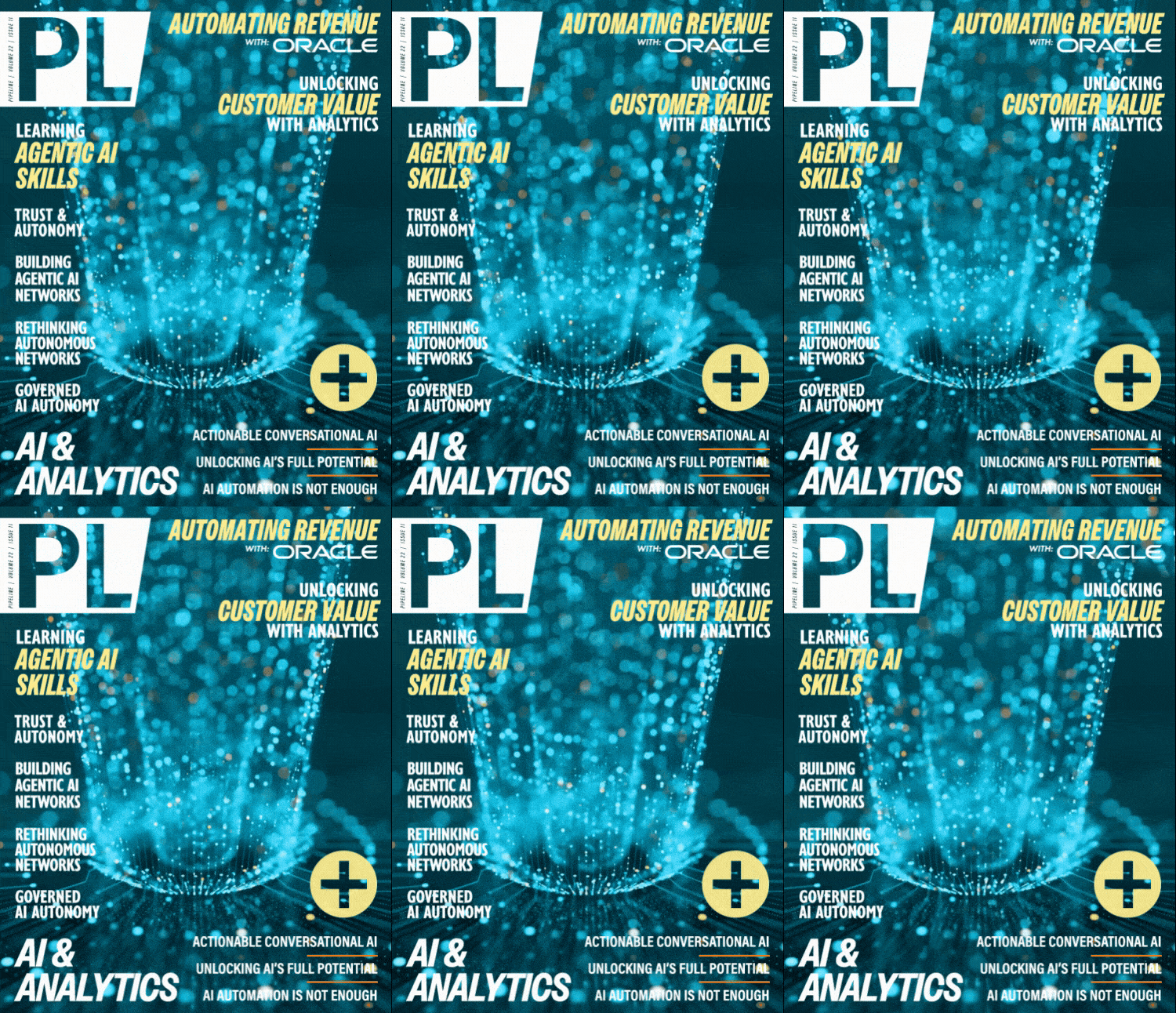
In this issue of Pipeline, we explore AI, Automation and Analytics. Oracle takes us beyond the agent, and examines what Autonomous Revenue Management actually means. Maria Popo of The Society of Cable Telecommunications Engineers explores the opportunities and challenges of integrating AI into human skills and workforce development. Nokia contends fiber broadband is the foundation to meet the demands of AI and monetize the AI economy. Guy Lupo of the TM Forum proposes that the race to autonomous telecoms is both an AI race and a trust race. Etiya presents agentic transformation in telco as a phased roadmap from agent-ready foundations to fully governed autonomy. Ribbon Communications articulates why AI-native operational platforms are better positioned to help service providers move beyond reactive management toward more predictive, automated, and autonomous operations. Tollring walks us through a four-stage progression of conversational AI maturity. Mobileum shares five main areas where human-in-the-loop is critical to unlocking AI’s full potential. afina argues that the data flowing through telecom networks is worth far more than the connectivity fees operators charge to carry it, and their co-founder reveals a three-step transformation playbook. Dr. Mark Cummings explains why AI automation is not enough for organizations to thrive in a post-genAI world. All this, plus the latest enterprise and telecommunications technology industry news and more.We hope you enjoy this and every issue,
Scott St. John
Managing Editor
Pipeline
Follow on LinkedIn | Follow Pipeline